Memphis workers win a livable wage by building on a legacy of solidarity

It was a victory for a livable wage that was 58 years in the making.
AFSCME Local 1733 members who keep Memphis, Tennessee, running are celebrating a hard-fought victory after the Memphis City Council voted to approve a proposal last week providing city workers a livable wage.
But getting there took persistence and solidarity – both of which Local 1733 members know best, given their role in making U.S. civil rights history.
The fight over worker pay, respect and dignity prompted Local 1733 members to launch the 1968 Memphis Sanitation Workers’ Strike. The workers who provide public services to Memphis residents have been fighting for livable wages for years since then.
“We stand on the shoulders of giants,” said Jeremy Shaw, a CDL driver and a Local 1733 member. “And every day that we show up, we become the giants others will one day stand on.”
Making living in Memphis possible
For 28 years, O. Shawun Smith has helped keep Memphis clean and running as a sanitation truck driver. It’s service he takes pride in, and work that keeps his community moving. But after getting underpaid for years, Smith and his fellow city workers knew that dedication alone won’t pay the bills.
“It was well over time for the city to pay us a fair wage for a hard day’s work,” Smith said.
The latest fight for fair pay began in March. Local 1733 members came together to demand pay that reflected the essential services they provide every day. Furthermore, they demanded a wage that allows them to actually afford to live in the city they serve.
“A living wage is the basic building block to life,” said Jarvis Hymon, an environmental enforcement officer and longtime Local 1733 member. “If I can provide for my family, I can survive.”
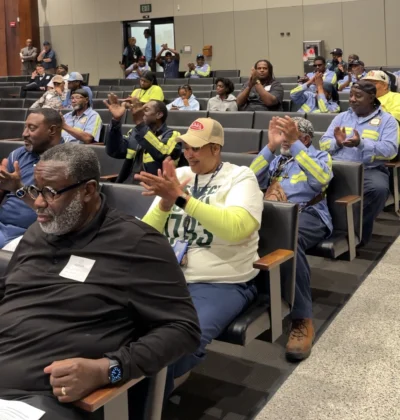
In the spring, the workers reached a memorandum of understanding (MOU) with the city, but the pay increases still did not equal a livable wage. And by July, the new MOU was still yet to be signed. So, Local 1733 members gathered again to raise their voice, and launched the “RESPECT LOCAL 1733” campaign, whose themes echoed the 1968 “I AM A MAN” campaign.
“The members that came before us built our union’s power by never quitting or taking no for an answer,” Shaw said. “We build on that legacy by never backing down.”
The livable wage campaign
Through a public pressure campaign, petitions, letters, worksite meetings, and one-on-one conversations, Local 1733 shared an important message: city services matter, and so do city workers. Members worked hard to build support by reaching their fellow members, co-workers, community organizations, civic and civil leaders, City Hall, and the larger Memphis community.
By early August, Mayor Paul Young signed the MOU and agreed to support a proposal to provide raises that would bring city workers up to a livable wage.
While the proposal had the mayor’s support, it went on to be rejected and repeatedly delayed for months. The progress might have been stuck in City Hall, but Local 1733 workers never quit.
AFSCME workers continued to show up and serve their Memphis neighbors every day even as they stood shoulder to shoulder in their fight for respect and dignity on the job. They continued to speak out, join meetings, share information with community members, call councilmembers, and show up at each City Hall meeting.
“I have been proud to serve my Memphis brothers and sisters for the last 15 years,” said Tomorrow Bonds, a semi-skilled crew member and Local 1733 member. “And our demands will be seen and heard so I can continue to do so.”
That determination built the support needed for the wage increase proposal to pass committee unanimously, and on November 10, the Memphis City Council approved the proposal.
Long-overdue pay raises
“This agreement shows what city workers can accomplish when we stay united, speak up, and don’t give up,” said Adrian Rodgers, president of Local 1733. “Our members never backed down because they know the value of the work they perform every day.”
The agreement establishes a $22-an-hour baseline for every covered worker earning less than that amount. Most sanitation workers will also receive an additional increase of up to 5%. Combined, the increases provide hundreds of AFSCME city workers with raises of up to 12%.
“A livable wage means my family and I can keep up with the rising cost of living,” said Bonds. “We’ll be able to put food on the table without having to sacrifice other life essentials.”
This victory adds another chapter to the legacy of Memphis sanitation and public workers fighting for and winning dignity and respect on the job.
“The next victory starts with coming together,” said Shaw.